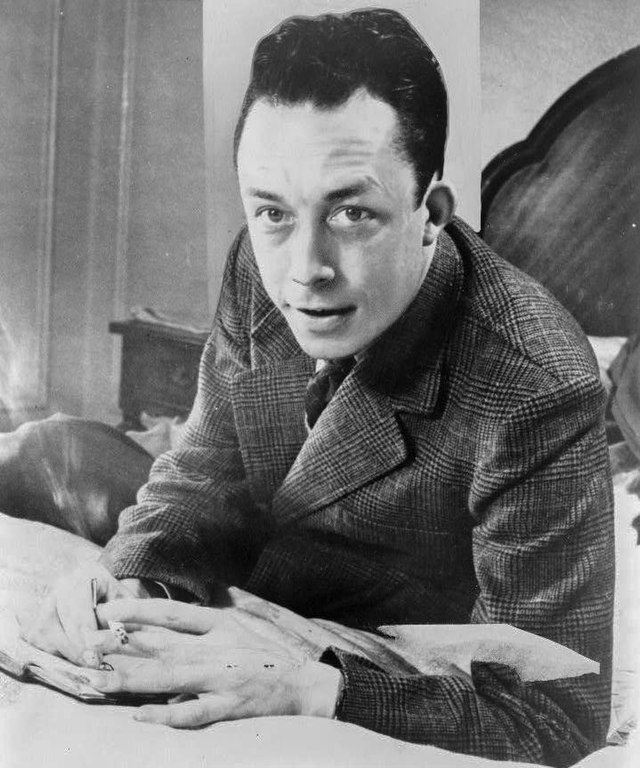
Albert Camus was a French philosopher, author, dramatist, journalist, world federalist, and political activist. He was the recipient of the 1957 Nobel Prize in Literature at the age of 44, the second-youngest recipient in history. His works include The Stranger, The Plague, The Myth of Sisyphus, The Fall, and The Rebel.
Personal Life
Albert Camus, born on November 7, 1913, in Mondovi, French Algeria, had a tumultuous upbringing marked by his father's death in World War I. Raised by his mother and older brother in the working-class district of Belcourt, Algiers, Camus experienced poverty but also found solace in literature and education. Despite recurrent health issues, he excelled academically and earned a scholarship to attend the Grand Lycee, where he developed a keen interest in philosophy and literature.
In the 1930s, Camus embarked on a journey of self-discovery, grappling with tuberculosis and personal relationships while immersing himself in journalism, theatre, and politics. He briefly joined the Communist Party, but his disillusionment led him to advocate for individual freedom and oppose totalitarianism. His debut novel, "The Stranger," catapulted him to literary fame, and he became an influential figure in the French Resistance during World War II.
After the war, Camus continued to write and engage in political activism, earning international recognition for works such as "The Plague" and "The Rebel." Despite facing criticism for his views, particularly his opposition to Marxism-Leninism and his stance on the Algerian War, Camus remained committed to championing human dignity and moral integrity.
In 1957, Camus was awarded the Nobel Prize in Literature, a testament to his literary achievements and humanitarian ideals. Tragically, his life was cut short in a car accident on January 4, 1960, leaving behind a legacy of existential thought and unwavering commitment to justice and compassion. Camus's enduring influence extends beyond his literary works, inspiring generations to confront the absurdities of existence with courage and integrity.
Publications
Lorem ipsum...
Lorem ipsum...
Lorem ipsum...
Lorem ipsum...
Lorem ipsum...
Views
Existentialism
Camus's critique of existentialism stems from his belief in the fundamental differences between his philosophical origins and the existentialist movement. He distances himself from existentialist thinkers like Sartre, rejecting their emphasis on historical determinism and the precedence of existence over essence. Instead, Camus finds his philosophical roots in ancient Greek philosophy, Nietzsche, and 17th-century moralists. While existentialism grapples with the absurdity of existence, Camus's divergence lies in his assertion that individuals should embrace the absurd rather than seeking to create meaning in a seemingly meaningless world. He rejects suicide as a solution to life's absurdity, urging individuals to confront the inherent meaninglessness of existence with courage and defiance.
Absurdism
Camus's exploration of the absurd aligns with existentialist themes but also introduces distinct nuances. He defines the Absurd as the confrontation between human need and the unreasonable silence of the world, acknowledging the inherent meaninglessness of existence. Unlike nihilism, Camus does not advocate for despair or resignation in the face of the Absurd. Instead, he proposes that individuals accept the absurdity of life and find meaning through their actions and choices, rejecting suicide as a rejection of human values and freedom. While initially associated with the label of "philosopher of the absurd," Camus's later work reflects a shift away from strict identification with absurdism, indicating a more nuanced perspective that scholars often refer to as the Paradox of the Absurd.
Revolt
In "The Rebel," Camus expands on his philosophical framework by articulating the concept of revolt as a response to injustice and oppression. He distinguishes between revolution and rebellion, cautioning against the potential for revolutionary movements to devolve into oppressive regimes. Camus emphasizes the importance of ethical action in the face of a seemingly indifferent universe, asserting that the experience of the Absurd provides the basis for moral values and ethical behavior. He identifies two modes of rebellion: metaphysical rebellion, which protests against the human condition and the absurdity of existence, and historical rebellion, which seeks to effect change in the world. Throughout his exploration of revolt, Camus grapples with the ethical implications of rebellion, emphasizing the need to balance the pursuit of justice with the avoidance of unjustifiable suffering.